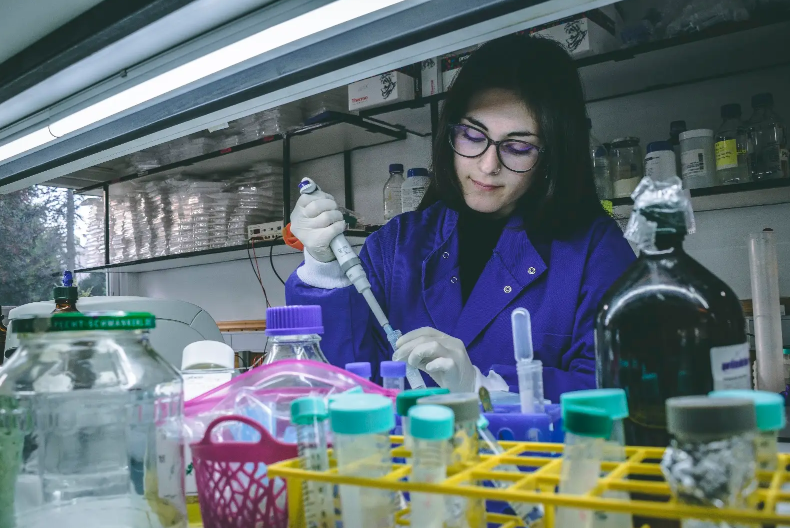
Researchers from the “Animal Health in Marine Environments” programm at the Interdisciplinary Center for Aquaculture Research (INCAR) have been awarded funding through the FONDECYT Exploration 2025 competition for the project titled “Development of PROTAC Technology as a Novel Antiviral Strategy Against the Infectious Pancreatic Necrosis Virus in Salmonids.” This initiative aims to push the boundaries in combating viral fish diseases through cutting-edge technologies.
The four-year project will be led by Dr. Jaime Figueroa Valverde, Principal Investigator at INCAR, with collaboration from Dr. Guillermo Valenzuela Nieto, faculty member at Universidad San Sebastián and former postdoctoral researcher at INCAR, and Dr. Denise Haussmann, faculty member at Universidad Santo Tomás in Valdivia.
The main goal is to develop a prototype of PROTAC (PROteolysis-TArgeting Chimeras) technology, a molecular tool designed to target and degrade specific proteins. In this case, it will focus on the VP2 protein of the Infectious Pancreatic Necrosis Virus (IPNV)—one of the most persistent and impactful viral diseases in salmonids.
PROTAC Technology: A Groundbreaking Antiviral Approach in Fish
This technology represents an unprecedented scientific challenge in aquaculture, with no prior reports of its use against fish viruses, particularly within the Chilean context. The project intends to demonstrate that the PROTAC system, widely characterized in mammalian models, can be effectively adapted for use in fish cells, opening new doors for disease control in the salmon farming industry.
“PROTAC systems have been widely developed using various antiviral molecules. They harness the cell’s own machinery to selectively eliminate unwanted proteins within infected cells. This approach has proven useful in treating diseases such as cancer and neurodegenerative disorders. Clinical trials involving PROTACs are on the rise, showcasing significant promise in tackling complex conditions and reinforcing the role of this technology in biotech and medicine,” explained Dr. Jaime Figueroa.
According to the researchers, PROTACs offer an innovative route to tackle viral diseases in fish, such as IPNV, which severely affects commercially important aquatic species. Dr. Figueroa adds: “Traditional antiviral therapies in aquaculture have often fallen short, especially in treating complex viral infections. By targeting key viral proteins like VP2 in IPNV, PROTACs could provide a more specific and effective alternative to conventional therapies.”
Beyond precision, this method may also reduce the risk of viral resistance—an ongoing challenge with broad-spectrum antiviral drugs.
If progress is made with PROTAC technology against IPN, it may pave the way for treatments against other viruses affecting salmon farming. The aquaculture industry, like other animal production systems, typically relies on genetic enhancement to breed resistant strains, yet no such approach covers the full pathogen spectrum. Vaccines serve as the first line of defense, and for bacterial infections, antimicrobials offer secondary support. But when vaccines for viral infections fail or underperform, there’s little to fall back on—except for preventive cleaning and disinfectants. That’s why PROTAC systems emerge as a pioneering and unexplored alternative in aquaculture globally, especially in Chile.
The research will be jointly carried out by the Fish Molecular Biology Lab at Universidad Austral de Chile (UACh) and the Biotechnology Exploration Lab at Universidad San Sebastián (USS), forging a strategic alliance to tackle critical challenges in Chilean aquaculture.
🔍 Finally, due to the disruptive nature of the proposed technology, researchers emphasize the need for an exhaustive patentability analysis to explore securing intellectual property rights for the innovation.
The project is expected to achieve a TRL2 (Technology Readiness Level), with hopes of advancing to TRL4 through future FONDEF funding.